

Explosion-proof equipment must match the hazardous-area classification, the material that could ignite, and the equipment’s certification. To understand how to choose explosion proof equipment, start by identifying whether the U.S. location is classified as Class I Division 1 or Class I Division 2. Area classification is the first selection step; the protection method and certification must also suit the actual atmosphere and operating conditions.
Certification labels can look similar, but they reflect different frameworks and do not replace matching equipment to the hazard. This guide explains explosion-proof equipment and how enclosure design, intrinsic safety, and purge systems differ. It also shows what to compare across ATEX, IECEx, and North American certifications, and how gas or dust classification, temperature limits, and site conditions affect selection.
Key Takeaways
- Start with the hazardous-area classification. It sets the baseline for matching equipment to the location.
- Compare certification markings against the applicable protection method and the atmosphere present at the site.
- Understand how enclosure design, intrinsic safety, and purge systems manage ignition risks in different ways.
- Match equipment type to operational needs, including Ex-certified ventilation for hazardous industrial environments.
ATEX, IECEx, cULus, CSA, FM, and UL certifications
Certification marks identify the framework used to assess equipment, but they do not replace hazardous-area classification. Compare the marking with the process, installation location, and destination market.
ATEX and IECEx Certification Systems
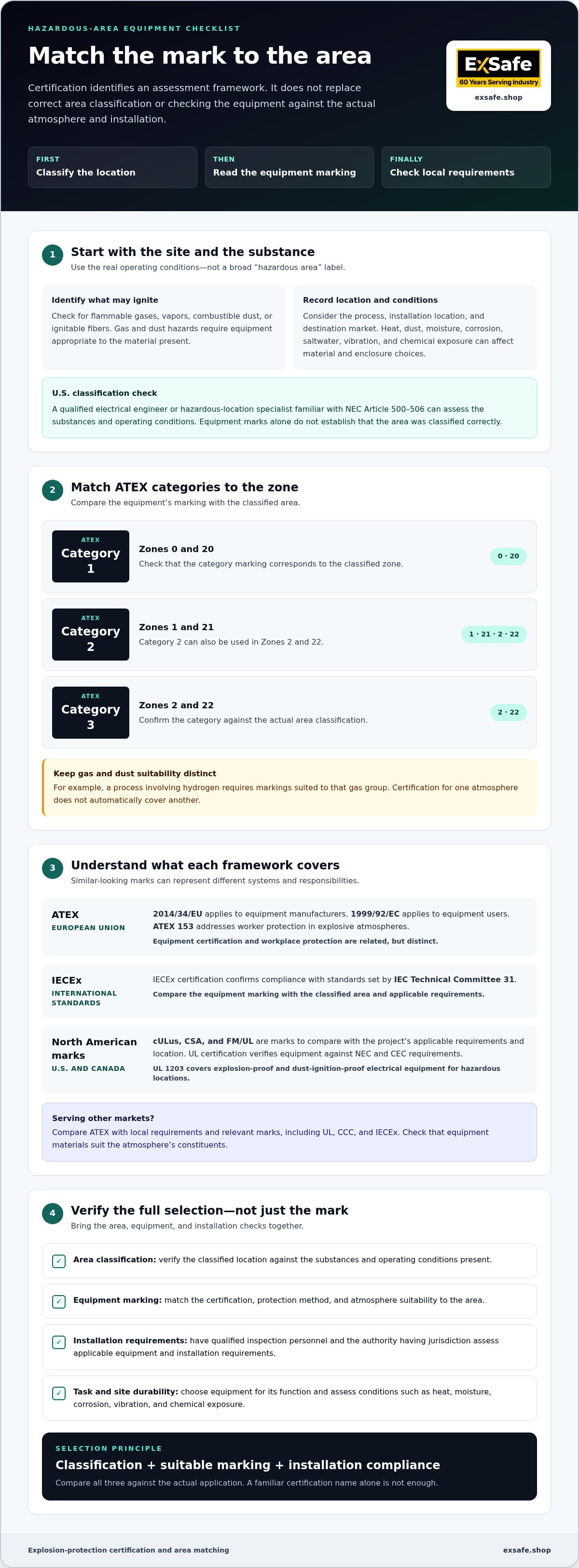
ATEX and IECEx are separate systems for assessing equipment used in explosive atmospheres. ATEX Category 1 covers Zones 0 and 20; Category 2 covers Zones 1 and 21, and can also be used in Zones 2 and 22; Category 3 covers Zones 2 and 22. IECEx certification confirms compliance with standards set by IEC Technical Committee 31. For procurement, match the equipment’s marking to the classified area, not just to a familiar certification name.
ATEX Directives and Local Requirements
ATEX Directive 2014/34/EU applies to equipment manufacturers, while ATEX Directive 1999/92/EC applies to equipment users. In the European Union, ATEX 153 addresses worker protection in explosive atmospheres. These roles matter: equipment certification and workplace protection are related but distinct considerations. For plants serving other markets, compare ATEX with local requirements and relevant marks, including UL, CCC, and IECEx. Equipment materials must also suit the atmosphere’s constituents so they don’t impair explosion protection, according to EUR-Lex.
U.S. Area Classification and Compliance Verification
In the United States, a qualified electrical engineer or hazardous-location specialist familiar with NEC Article 500-506 can assess area classification using the substances and operating conditions present. Qualified inspection personnel and the authority having jurisdiction assess whether equipment and installation meet applicable requirements. This distinction matters: an equipment mark alone doesn’t establish that the area was classified correctly.
Compare the classification, equipment marking, and installation requirements together. UL 1203 covers explosion-proof and dust-ignition-proof electrical equipment for hazardous locations. UL certification verifies equipment against NEC and CEC requirements. cULus, CSA, and FM/UL are North American certification marks to compare against the project’s applicable requirements and location.
What Is Explosion Proof Equipment?
Hazardous environments may contain flammable gases, vapors, combustible dust, or ignitable fibers. Electrical equipment for these areas is designed to reduce ignition risk.
To understand how to choose explosion proof equipment, first identify the hazardous material, the equipment’s function, and the conditions at the worksite.
Combustible Gases and Dust
Combustible gases and dust present different hazards, so identify the substances that may be present before selecting equipment. A chemical process involving hydrogen, for example, requires markings suited to that gas group. Dust-producing operations need equipment appropriate for the combustible material and area classification. Certification for one atmosphere does not automatically cover another.
When deciding how to choose explosion proof equipment, compare its markings with the actual substances and operating conditions. Do not rely on a broad “hazardous area” label alone.
Equipment Used in Hazardous Environments
Examples include electrical instruments, power distribution equipment, portable lighting, and portable ventilation equipment. Each serves a different purpose, so select equipment for both the task and the classified area. A portable inspection light, for instance, has a different role from equipment that distributes power to several tools.
Site conditions also affect durability. Heat, dust, moisture, corrosion, saltwater, vibration, and chemical exposure can influence material and enclosure choices. Materials must be compatible with the potentially explosive atmosphere, so assess these conditions alongside the gases, vapors, or dust present.
Equipment cost depends on its type, protection method, certification, materials, and operating demands. Compare options with the application’s requirements rather than treating purchase price as a measure of suitability.
How explosion-proof equipment works
Explosion protection controls how electrical equipment interacts with an explosive atmosphere. The key concern is ignition: an arc, hot surface, or fault must not ignite flammable gas, vapor, or dust outside the equipment. Different protection methods address this risk in different ways.
With Ex d protection, a robust enclosure is designed to contain an internal ignition. If gases ignite inside, the enclosure cools escaping gases below their ignition temperature before they reach the surrounding atmosphere. This does not mean an internal explosion is impossible. Instead, the enclosure is designed to prevent it from igniting the external hazardous atmosphere. Select Ex d equipment according to its marking and suitability for the classified location.
Intrinsic safety takes a different approach. It limits electrical energy, including circuit current and voltage, before it reaches a hazardous area, helping prevent ignition. This method can suit instrumentation and wireless sensors where limiting energy is central to the design. Unlike enclosure-based protection, intrinsic safety controls the energy available in the circuit. The method must match the equipment’s application.
Purge systems use a controlled supply to maintain positive pressure inside an electrical enclosure and prevent hazardous gases from entering. This differs from Ex d, which manages ignition within the enclosure, and intrinsic safety, which limits circuit energy. These approaches show why the protection method and certification must be considered together. Compare the equipment’s protection designation and intended application with the area classification and relevant safety standards. Match the method to the ignition pathway, not just the equipment category. A process area may require a different approach from a sensor circuit in a hazardous zone.
ExSafe: Ex-certified Ventilation
ExSafe supplies Ex-certified ventilation for hazardous industrial environments where air movement is part of the equipment specification. Its products comply with ATEX and IECEx standards for Zone 1 and Zone 2 areas. Match the ventilation equipment to the site classification and operating conditions identified during your selection process.
ExSafe also supplies Ex-certified power distribution and heating for projects that require several types of certified equipment. Keep each item’s function and suitability for the hazardous area in view when defining the procurement scope.
Contact ExSafe to discuss Ex-certified ventilation for your hazardous-area requirements.
Turn Your Area Assessment Into a Clear Specification
Make the next procurement step a written equipment specification linking the area assessment to each item’s intended function. Knowing how to choose explosion proof equipment means carrying those requirements through purchasing and installation, rather than treating a certification mark as the whole decision.
ExSafe supplies Ex-certified ventilation, lighting, and power distribution for hazardous industrial environments. Each category addresses a different operational need, so keep the site classification and equipment application central as you define the scope.
Use that specification to guide the conversation about suitable equipment for your operation. Contact ExSafe about your equipment needs and take the next step with a clear basis for your decisions.
Frequently Asked Questions
Do both meet OSHA and NEC requirements?
Neither intrinsic safety nor explosion-proof construction alone guarantees that an entire installation meets applicable requirements. The equipment must suit the classified location, and the complete installation must follow relevant requirements, including NEC Article 500-506 and applicable OSHA safety standards. For example, an approved device can still be unsuitable if its marking doesn’t match the area classification or intended application.
Summary: Which One Should You Choose?
Choose the protection method that matches the classified location and equipment application. Intrinsically safe equipment is identified for Zones 0, 1, and 2 and Divisions 1 and 2. Explosion-proof equipment is identified for Zones 1 and 2 and Division 1. For a wireless sensor in Zone 0, intrinsic safety is the relevant option described here.
What Is Intrinsically Safe Equipment?
Intrinsically safe equipment limits electrical energy so a circuit cannot provide enough energy to ignite the surrounding atmosphere. It controls current and voltage rather than containing an ignition inside an enclosure. This makes the method relevant to low-energy devices such as wireless sensors used in Zone 0, where explosive gases may be present continuously.
Which is more cost-effective?
Neither method is universally more cost-effective. Compare the complete system against the application: intrinsic safety may require compatible circuit components, while enclosure-based protection affects equipment selection and installation. Consider device function, protection method, certified area suitability, and integration needs together, rather than comparing purchase prices alone.
What are the hazardous location classes, divisions, and zones in the US?
U.S. hazardous locations can be classified using Classes and Divisions or the Zone system. Classes distinguish the type of hazardous material, while Divisions and Zones describe the hazardous-area classification. Relevant identifiers include Class I Division 1 and Division 2, gas Zones 0, 1, and 2, and dust Zones 20, 21, and 22.